Precision Aluminum Profile Bending & Stretch Forming: The Complete Technical Guide for Industrial, Architectural & Automation Applications


Author
In the quest for the ultimate relaxation experience, our sofas are designed with your well-being in mind. Every curve and cushion is engineered to support and embrace your body's contours, creating a sense of comfort that feels tailor-made. We delve deep into the science of seating to ensure that with every moment you spend on our sofas, you feel the world melt away. Build all at once or add on over time. If you change your space, you can always change the shape.
Marie R. Winters


As modern industrial manufacturing continues to evolve towards lighter weight, higher strength, and more complex structures, aluminum profiles are rapidly expanding beyond their traditional use in building doors and windows into a variety of high-demand applications—including rail transit, new energy equipment, medical devices, automation machinery, and architectural envelopes. In non-standard automated production lines, irregular curtain walls, equipment chassis, and curved structural components, profile drawing and precision stretch bending have become decisive manufacturing processes determining structural stability and aesthetic presentation. Foshan Nanhai Yuebao Technology Co., Ltd. integrates nearly a decade of extrusion knowledge with multi-axis CNC bending and deep machining, providing seamless one-stop solutions from CAD review to volume fabrication.
Aluminum profile stretch bending is not merely applying external mechanical force; it is an exact engineering science integrating solid mechanics, tooling geometry, and servo precision. Unlike conventional press braking or roll forming, stretch bending applies controlled axial tensile forces throughout the bending trajectory. This shifts the neutral layer of the cross-section inward, placing the entire cross-section in tensile or controlled stress states. Consequently, elastic springback is dramatically reduced, and cross-sectional distortion is effectively suppressed—making it the gold standard for large-radius curves, complex thin-walled hollow sections, and components demanding exact contour repeatability.
Yuebao Technology is equipped with heavy-duty multi-axis CNC stretch bending machines paired with an extensive proprietary mold library. We comfortably form profile cross-sectional widths ranging from 20mm to 200mm, with curvature capabilities extending from tight localized arcs to large-radius architectural sweeps. For 6063 aluminum alloy—celebrated for its superb extrusion formability, fine grain structure, and anodizing receptivity—parameter sensitivity is acute. Through years of empirical testing, Yuebao's engineering team has established mathematical control models governing elongation rate, bending speed, and post-stretch tension across diverse wall thicknesses, guaranteeing that curved workpieces retain precise curvature and dimension stability following residual stress release.
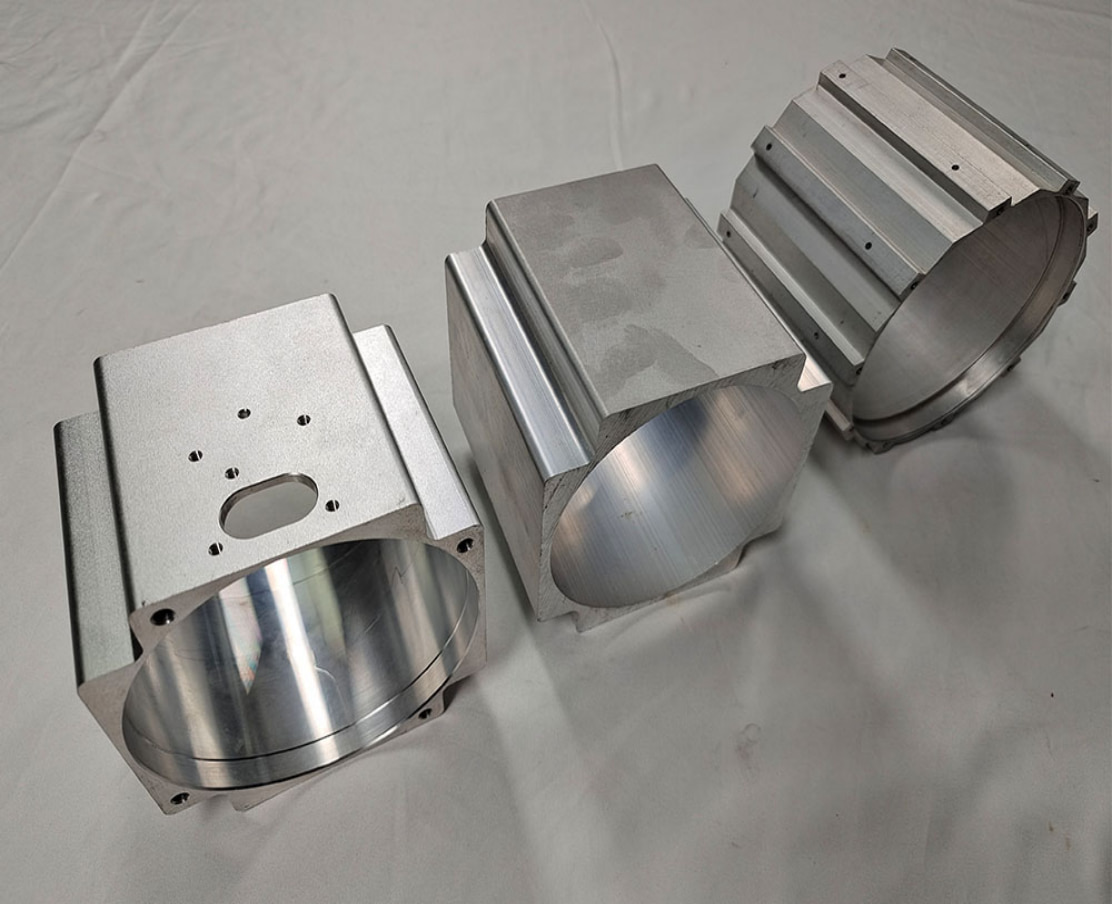
In automated assembly lines and robotic workcells, bent aluminum profiles are vital structural elements—commonly engineered into circular guide rail supports, curved protective cover frames, seventh-axis robot linear travel tracks, and curved gantries for optical inspection equipment. These applications demand rigorous angular accuracy while maintaining strict axial straightness and torsional limits, ensuring that curved components interface seamlessly with straight guide rails and precision drive mechanisms.
Yuebao Technology resolves assembly bottlenecks through an integrated "Bend First, CNC Machine Second" manufacturing route. For instance, when producing a curved 6063-T5 square tube frame:
- The profile is first stretch bent to the exact CAD radius under closed-loop servo control.
- The bent part is loaded onto custom vacuum-assisted hydraulic fixtures in a 5-axis CNC machining center.
- End faces are angle-cut, beveled, and drilled with high-tolerance mounting holes and tapped threads in a single datum setup.
This sequence completely eliminates the hole elongation and pitch drift common in pre-drilled bent profiles. Coupled with precision post-bend calibration and uniform surface anodizing, the final components deliver structural rigidity and industrial elegance.
| Bending Process | Mechanics & Method | Key Technical Limitations | Yuebao CNC Stretch Bending |
|---|---|---|---|
| Press Brake Bending | Three-point localized punch force | High stress concentration; severe outer flattening | Continuous tension; zero punch mark or flat spot |
| Roll Bending (Pyramid) | Continuous progressive 3-roll drive | Surface roll friction marks; straight unbent ends | Polymer-protected dies; seamless arc transition |
| Rotary Draw Bending | Clamping die rotates around bend die | Limited to smaller tubes; wall thinning >10% | Wall thinning <5%; hollow collapse <0.5% |
[A] Specialized Solutions for Asymmetrical & Hollow U-Sections
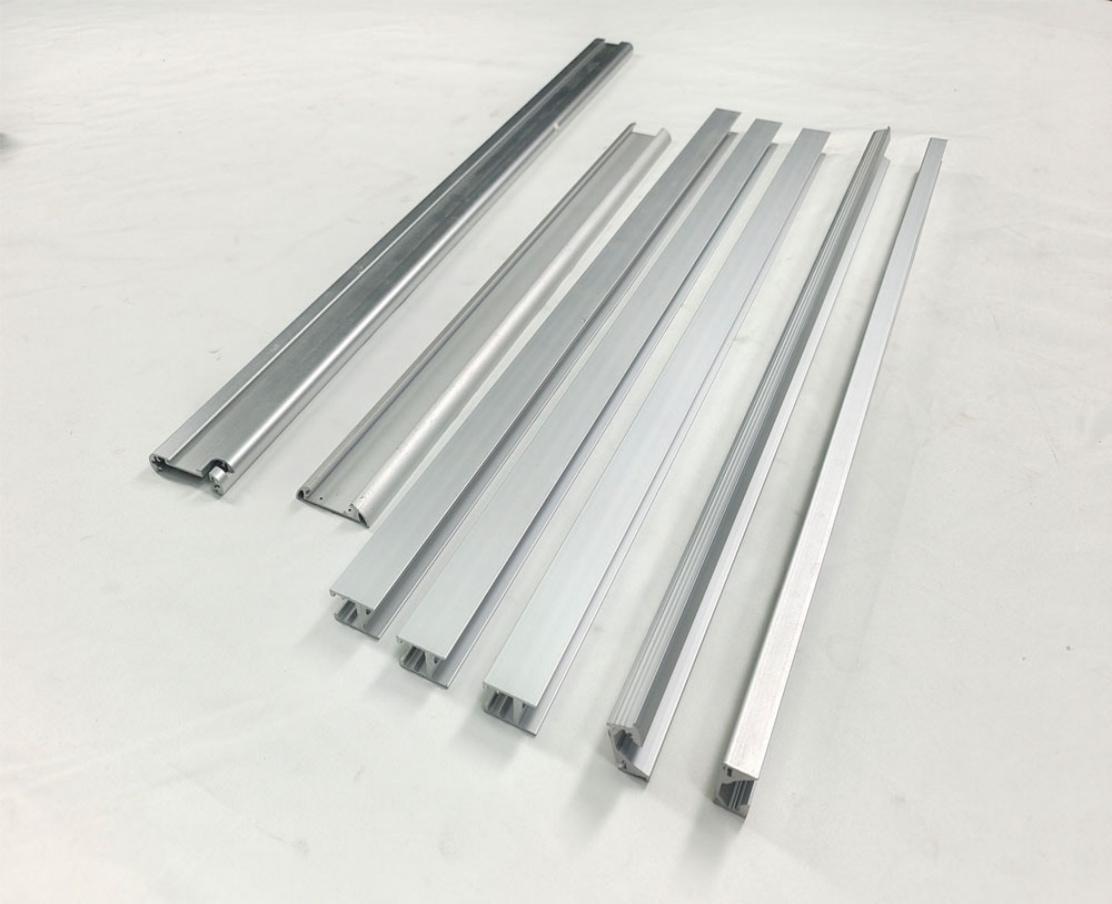
Special-shaped profiles featuring asymmetrical internal ribs, multi-cavities, or open grooves are vulnerable to web buckling, flange sinking, and torsional twisting during bending. At Yuebao Technology, comprehensive finite-element cross-sectional stress analysis precedes tooling fabrication. For open U-shaped profiles where bending tension naturally causes the opening to contract inward, we deploy custom internal flexible segmented mandrels and polyurethane fillers. This balances transverse stresses, locking groove dimensions to drawing tolerance and ensuring effortless downstream insertion of rubber seals or glass panels.
[B] Variable Curvature Control (Ellipses & Parabolas)
Beyond constant-radius circles, advanced architectural structures and ergonomic medical equipment casings often call for non-circular geometries like ellipses, parabolas, and multi-tangent compound curves. Yuebao's multi-axis CNC stretch benders utilize real-time dynamic tension compensation, modulating servo pulling force and feed speed continuously. This achieves tangent-smooth transitions without visible joint lines, satisfying both structural stiffness and high aesthetic criteria.
[C] Comprehensive Sheet Bending + Profile Drawing Composite Assembly
Many industrial equipment enclosures require curved sheet metal panels welded or fastened to structural extrusion frames. Equipped with CNC press brakes handling aluminum plate thicknesses from 0.5mm to 6.0mm (minimum internal radius R0.5), Yuebao Technology supplies unified multi-process assemblies. For example, in laser marking machine cabinets, the curved top canopy is formed via sheet bending, while perimeter support columns are stretch-bent from matching 6063 profiles. Single-source fabrication avoids cross-vendor dimensional mismatch and drastically shortens customer procurement cycles.
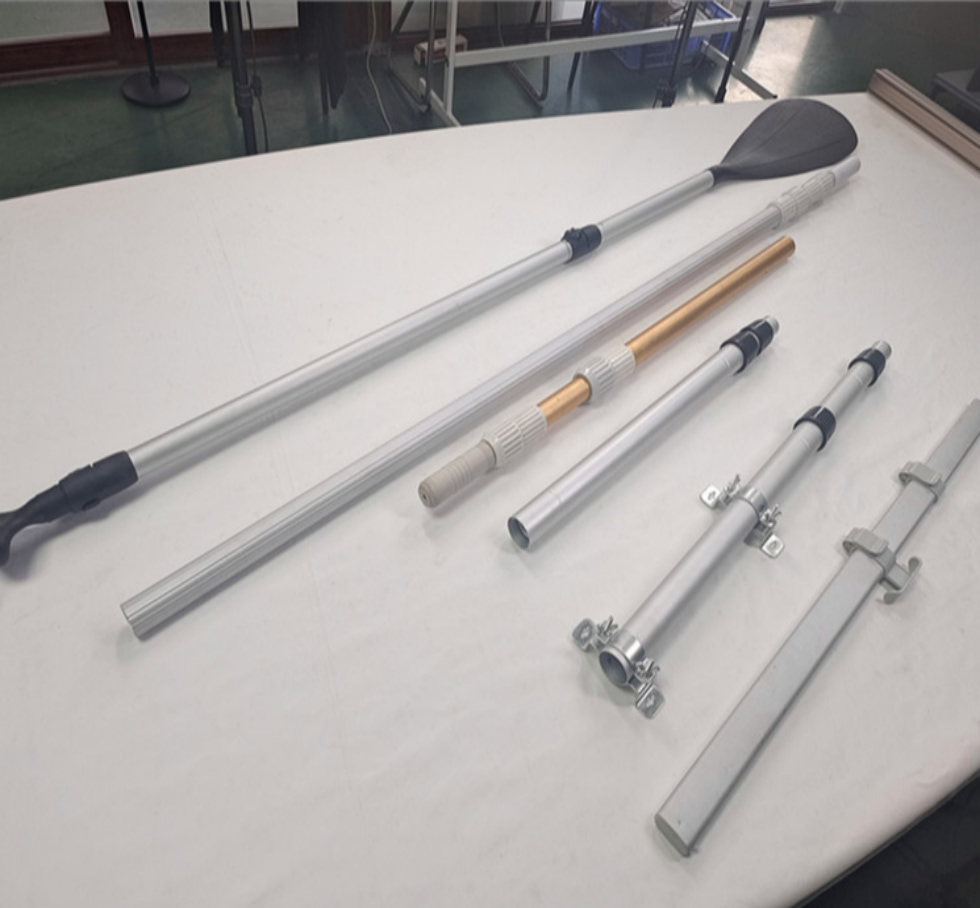
Situated in Nanhai District, Foshan City—the epicenter of China's aluminum extrusion and fabrication industry—Foshan Nanhai Yuebao Technology Co., Ltd. serves global industrial OEMs, architectural contractors, and Tier-1 equipment makers with end-to-end engineering excellence:
Large-Scale Bending Capacity
Equipped with large CNC stretch benders handling uninterrupted profiles up to 6 meters in length and section widths up to 200mm, sustaining arc contour precision within ±1.0mm across volume production runs.
Surface Protection Technology
We utilize specialized polymer cushion gaskets and micro-mist lubricants throughout the pulling cycle, preventing surface scratches and die burn marks to deliver pristine surfaces ready for high-grade anodizing or powder coating.
In-House Full Processing
From raw extrusion and CNC stretch bending to 5-axis milling, laser cutting, welding, and surface treatment, everything remains under one roof—ensuring rapid 3-day prototyping and 15-day mass order turnaround.
Strict Quality Certification
Adhering strictly to ISO9001 and GB/T 5237-2017 standards, every bent batch undergoes CMM radius inspection, ultrasonic wall thickness checks, and assembly tests, sustaining an ex-factory pass rate exceeding 99.2%.
Q1: What is the minimum bending radius achievable for custom aluminum profiles?
The minimum bending radius is primarily governed by the profile's wall thickness, outer width, and alloy temper. Generally, for 6063-T5 aluminum, the minimum centerline bending radius (R) is roughly 2.5 to 3 times the profile cross-sectional height in the bending plane. For special tight-radius designs, our engineering team can perform localized annealing or customize internal support mandrels to prevent fracture.
Q2: Why does Yuebao recommend CNC machining after bending rather than before?
If mounting holes, precision slots, or end chamfers are machined while the profile is still straight, the subsequent stretch bending process induces uneven longitudinal strain and tensile elongation. This inevitably stretches circular holes into ovals and causes bolt hole centers to drift. Machining on our 5-axis CNC centers after bending guarantees true-to-drawing hole positions and assembly fit.
Q3: How do you prevent surface stretch marks on high-finish architectural profiles?
Visible stretch marks (Lüders bands) or die friction scratches often ruin anodized surfaces. Yuebao uses high-grade virgin 6063 ingots with controlled grain structures. During bending, custom polymer tooling inserts and water-soluble micro-lubricants prevent metal-to-metal rubbing. The finished curves can proceed directly to sandblasting and architectural anodizing without costly hand polishing.
Q4: Can your equipment bend complex curves such as ellipses or parabolas?
Yes. Our multi-axis CNC horizontal stretch benders feature programmable variable-curvature servo control. By interpolating multiple tangent radii along a single 6-meter workpiece, we form smooth transitional curves (ellipses, parabolas, S-bends) without segmented kinks, matching complex CAD geometry for medical diagnostic housings and modern curtain walls.
Q5: What design files and parameters should clients provide for a bending quote?
Please submit both 3D CAD files (STEP, IGES) and 2D engineering drawings (PDF, DWG). Clearly indicate the profile cross-sectional dimensions, outer/inner bending radius (or neutral layer radius), chord height, arc length, straight tail lengths at both ends, and required surface finish (anodized or powder coated).
Q6: How are custom bending dies managed, and who owns the tooling?
All custom bending dies, CNC clamping jigs, and flexible mandrels paid for by the customer remain 100% your proprietary property under formal Non-Disclosure Agreements (NDAs). Each tool is serialized, securely stored in our temperature-controlled mold warehouse, and maintained free of charge throughout the life of the project.
Plan Your Custom Aluminum Profile Bending Project with Yuebao
Need precision-bent aluminum profiles, complex multi-cavity curved frames, or integrated sheet metal assemblies? Send us your 2D/3D CAD drawings today. Our engineering team will review your bend radius feasibility, provide DFM optimization feedback, and deliver a competitive direct-factory quote within 24 hours.
- Tight-Tolerance Aluminum Fabrication for Medical Diagnostic Equipment: Cleanroom Finishing and ISO9001 Compliance
- Custom Aluminum Profile Bending & Mold Development: Core Capabilities, Quality Control, and Step-by-Step OEM Workflow
- Thermal Management in Servo Motor Housings: How Precision Extruded Aluminum Heat Sinks Maximize Cooling Efficiency
- Precision Aluminum Profile Bending & Stretch Forming: The Complete Technical Guide for Industrial, Architectural & Automation Applications
- Stretch Bending & CNC Machining for EV Battery Trays: Controlling Cross-Sectional Deformation Under 0.5%
- How to Ensure First-Time Success in Custom Aluminum Profile Prototyping: A Complete Engineering Guide
- How to Source Custom Aluminum Extrusions and CNC Parts from China: A Buyer’s Checklist
- Precision Custom Aluminum Enclosures for Heat Pumps, Energy Storage & EV Chargers