Thermal Management in Servo Motor Housings: How Precision Extruded Aluminum Heat Sinks Maximize Cooling Efficiency


Author
In the quest for the ultimate relaxation experience, our sofas are designed with your well-being in mind. Every curve and cushion is engineered to support and embrace your body's contours, creating a sense of comfort that feels tailor-made. We delve deep into the science of seating to ensure that with every moment you spend on our sofas, you feel the world melt away. Build all at once or add on over time. If you change your space, you can always change the shape.
Marie R. Winters


As industrial automation, robotics, and electric drive systems evolve toward higher torque density and compact form factors, the thermal management of servo motors and power inverters has become a decisive engineering bottleneck. In high-frequency 40, 60, 80, and 130 series servo motors as well as heavy-duty inverters, internal copper and iron core losses generate intense localized heat flux. Excessive thermal buildup inevitably triggers permanent magnet demagnetization, winding insulation breakdown, and IGBT thermal runaway. Foshan Nanhai Yuebao Technology Co., Ltd. addresses these severe thermal challenges by uniting high-aspect-ratio aluminum profile extrusion with precision multi-axis CNC deep machining, delivering drop-in ready aluminum heat sink housings that ensure rapid heat dissipation, structural rigidity, and IP67 hermetic sealing.
[01] High-Torque Overheating across 40/60/80/130 Motor Series
Servo motors operating in high-acceleration pick-and-place automation, CNC spindle drives, and robotics generate intense ohmic (I²R) resistance heat within stator copper windings alongside eddy current losses in iron laminations. When internal motor housing temperatures exceed 110°C–130°C, NdFeB permanent magnets risk irreversible thermal demagnetization, causing rapid torque drop, positioning instability, and motor burnout. A thermally conductive housing is not merely a cover; it is the primary heat sink conducting heat away from the stator.
[02] Inverter Power Module (IGBT) Hotspot Concentration
Modern industrial variable-frequency drives (VFDs) and solar/ESS inverters pack ultra-dense IGBT switches operating at multi-kilohertz frequencies. These modules generate concentrated heat fluxes exceeding 50 to 100 W/cm². Inadequate heat sink baseplate flatness or insufficient fin surface area results in dangerous junction-to-case temperature gradients, triggering overtemperature safety shutoffs and catastrophic semiconductor failure.
[03] The Cast Iron & Sheet Metal Thermal Barrier
Traditional cast iron or formed steel housings possess notoriously low thermal conductivity (approximately 50 W/m·K) and substantial deadweight. In contrast, 6063-T5 aluminum alloy achieves over 200–210 W/m·K—nearly quadruple the thermal dissipation capability at one-third the weight—providing optimal passive convection and forced-air cooling.
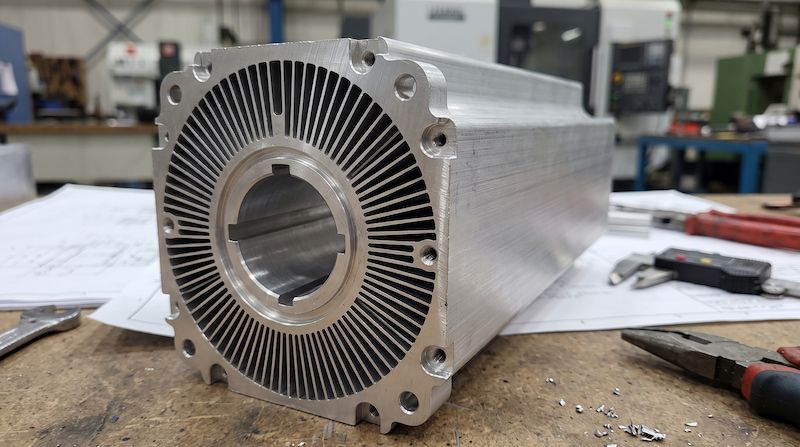
Maximizing convective cooling requires maximizing the outer surface area through dense perimeter cooling fins. However, in profile extrusion tooling, the Fin Aspect Ratio (the ratio of fin height to the gap between adjacent fins) represents a formidable manufacturing hurdle. Conventional aluminum extrusion mills struggle when aspect ratios exceed 10:1 or 12:1, resulting in broken die steel tongue mandrels, wavy fin tips, or inconsistent gaps that impede airflow.
At Yuebao Technology, we push metallurgical and die design limits to achieve fin aspect ratios up to 18:1 and even 22:1 using premium 6063-T5 virgin alloy:
- Tapered Fin Root Design: Thickened fin root geometry accelerates heat conduction from the internal cylinder outward, while tapered tips maintain laminar boundary layer stability.
- High-Rigidity Mold Tooling: High-grade H13/1.2344 ESR tool steels and advanced vacuum nitrogen heat treatment prevent tongue die deflection under 2,500+ ton extrusion pressures.
- Optimized Airflow Micro-Channels: Fin pitches are scientifically modeled via CFD (Computational Fluid Dynamics) to avoid thermal air stagnation under both natural convection and high-static-pressure forced fan air cooling.
| Thermal Manufacturing Route | Thermal Resistance & Efficiency | Structural Rigidity & IP Rating | Production Cost & Cycle |
|---|---|---|---|
| Die-Cast Aluminum Shell | Moderate (Alloy 380: ~96 W/m·K); internal gas pores create heat barriers | High rigidity; good IP sealing, but brittle under high torque shock | High upfront mold fees ($8k–$15k); rigid design revisions |
| Bonded / Welded Fin Heat Sink | Epoxy/solder thermal resistance layer limits heat transfer at fin roots | Prone to fin loosening under heavy motor mechanical vibration | Labor-intensive assembly; high unit production cost |
| Yuebao Integrated Extruded + CNC Shell | Zero thermal interface resistance; 100% monolithic 6063 metal conduction (>200 W/m·K) | Seamless monolithic tube; IP67 O-ring groove; zero vibration fatigue | Cost-effective extrusion dies; 3-day rapid prototyping; highly scalable |
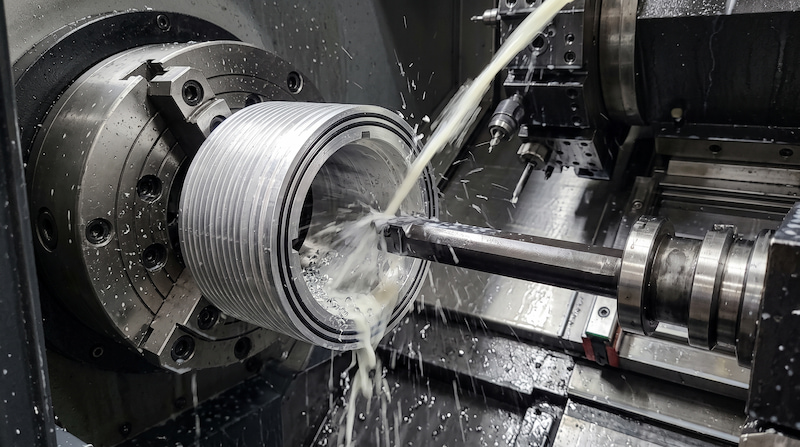
While profile extrusion forms the complex external finned geometry, achieving exact motor mechanical assembly requires surgical secondary CNC deep processing. The servo motor housing must interface tightly with the motor stator stack, front bearing flange, and rear encoder cover:
To ensure 100% surface contact for thermal conduction from the stator laminations into the aluminum shell, the internal diameter must maintain an interference fit (H7/p6 tolerance). Yuebao utilizes high-precision CNC lathe centers equipped with specialized internal anti-vibration boring bars, restricting roundness and cylindrical runout to within 0.015mm and coaxiality under 0.02mm.
Front and rear end-cap mating registers must be machined in a single clamping fixture setup to avoid angle deflection. Any concentricity misalignment between the front bearing bracket and rear housing causes rotor eccentricity, acoustic noise, high-speed vibration, and premature bearing failure.
Industrial automation and CNC machine tools expose servo motors to cutting fluids, coolant mist, and oil aerosols. We machine continuous precision O-ring grooves on both end faces with mirror-grade surface roughness (Ra ≤ 0.8μm). Followed by architectural-grade matte anodizing (silver, black, or blue), the external fins resist harsh industrial chemicals while maximizing thermal emissivity (ε ≥ 0.85).
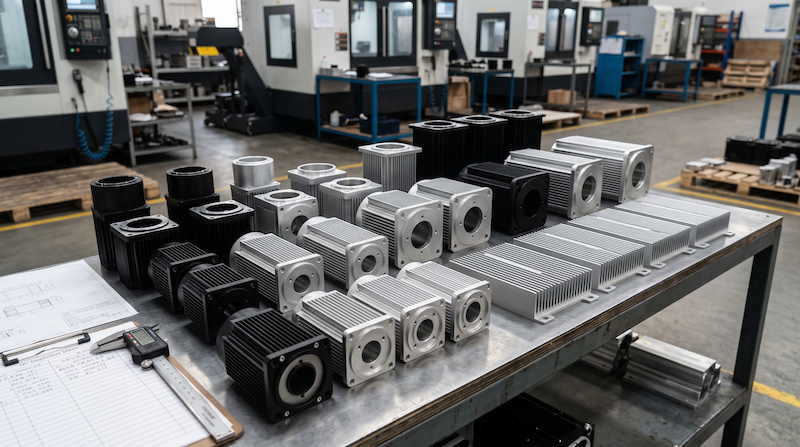
Headquartered in Nanhai District, Foshan City, Foshan Nanhai Yuebao Technology Co., Ltd. is a dedicated manufacturer of precision aluminum profiles and CNC mechanical components. With nearly a decade of deep processing expertise, we bridge design engineering and high-volume delivery:
High-Ratio Fin Tooling Mastery
Our tooling engineers design robust high-aspect-ratio dies exceeding 18:1 fin ratios, eliminating fin root fracture and delivering maximum heat transfer surface area for 40, 60, 80, and 130 frame sizes.
±0.015mm CNC Machining Precision
Equipped with multi-axis CNC lathes, 4-axis and 5-axis machining centers, and German laser cutting units, we guarantee tight concentricity, micro-inch surface finishes, and burr-free threaded holes.
Rapid Prototyping & Agility
Standard inventory profile shipping within 24 hours. Custom prototypes ready in 3 days, small-batch trials within 7 days, and full mass production batches delivered in 15 days direct from our factory floor.
ISO9001 & Worry-Free 90-Day Warranty
Every batch passes 23 rigorous inspection checkpoints—including CMM coordinate verification and pneumatic pressure leak testing—sustaining an ex-factory pass rate above 99.2% with a 90-day comprehensive warranty.
Q1: Which aluminum alloy is superior for servo motor heat sink housings: 6063 or 6061?
For most servo motor housings and inverter enclosures, 6063-T5 is the preferred choice. It delivers significantly higher thermal conductivity (200–210 W/m·K compared to ~167 W/m·K for 6061) and possesses exceptional extrusion flow characteristics required for forming dense, thin, high-aspect-ratio cooling fins. However, if the housing functions as an integral heavy load-bearing structural chassis subject to external mechanical forces, 6061-T6 is recommended for its higher yield strength.
Q2: What maximum fin aspect ratio can Yuebao achieve in motor profile extrusion?
While standard industry limits typically hover around 10:1 to 12:1, Yuebao Technology routinely achieves fin aspect ratios of 16:1 to 20:1, with customized designs reaching up to 22:1. Our advanced multi-stage nitrogen-hardened dies and controlled hydraulic extrusion speeds prevent die tongue breakage and wavy fin distortion.
Q3: How do you prevent out-of-round deformation during CNC boring of thin-walled motor shells?
Conventional three-jaw chucks apply localized radial pressure that distorts thin-walled tubes with external fins, causing ovality after unclamping. We deploy custom full-circumferential pie jaws and internal hydraulic expansion mandrels that distribute clamping force evenly. Combined with multi-pass fine boring and vibration-damped carbide tooling, we ensure roundness and concentricity remain strictly within ±0.015mm.
Q4: How is IP65/IP67 ingress protection ensured for outdoor inverters and washdown motors?
Ingress protection depends on precision register fits and smooth O-ring gasket channels. We machine dual-end face seal grooves to Ra 0.8μm surface finishes, guaranteeing proper elastomer gasket compression without micro-fissures. Every critical production batch can undergo pneumatic pressure decay leak testing to verify zero fluid penetration.
Q5: Does surface anodizing reduce or enhance the heat dissipation of aluminum housings?
Anodizing actually improves heat dissipation. While bare mill-finish aluminum has a very low thermal radiation emissivity (ε ≈ 0.05), a properly controlled anodized oxide layer (10–15μm) elevates emissivity to over 0.82–0.88. This substantially boosts radiative heat transfer to ambient air while delivering superior scratch and chemical corrosion protection.
Q6: Can Yuebao provide rapid prototyping for custom 40, 60, 80, or 130 servo motor frame sizes?
Yes. If adapting from our modular existing extrusion profiles, CNC machined functional samples can be delivered in just 3 business days. For entirely proprietary exterior fin profiles requiring a dedicated die, our rapid tooling service delivers T0 extrusion samples within 10–12 days, followed by mass volume delivery in 15 days.
Upgrade Your Motor & Inverter Thermal Performance Today
Developing high-efficiency servo motors, drive units, or power electronic inverters? Explore our specialized Custom CNC Machined Precision Aluminum Servo Motor Housing & Shells. Send your 2D/3D CAD models to our engineering team for a complimentary DFM thermal evaluation and transparent factory-direct pricing within 24 hours.
- Tight-Tolerance Aluminum Fabrication for Medical Diagnostic Equipment: Cleanroom Finishing and ISO9001 Compliance
- Custom Aluminum Profile Bending & Mold Development: Core Capabilities, Quality Control, and Step-by-Step OEM Workflow
- Thermal Management in Servo Motor Housings: How Precision Extruded Aluminum Heat Sinks Maximize Cooling Efficiency
- Precision Aluminum Profile Bending & Stretch Forming: The Complete Technical Guide for Industrial, Architectural & Automation Applications
- Stretch Bending & CNC Machining for EV Battery Trays: Controlling Cross-Sectional Deformation Under 0.5%
- How to Ensure First-Time Success in Custom Aluminum Profile Prototyping: A Complete Engineering Guide
- How to Source Custom Aluminum Extrusions and CNC Parts from China: A Buyer’s Checklist
- Precision Custom Aluminum Enclosures for Heat Pumps, Energy Storage & EV Chargers